Sunday, October 23, 2011


Tuesday, February 1, 2011
Tuesday, November 16, 2010
Our Haitian Family Needs Us
Please read e-mail First before you listen to understand. Interview with me on 102.3 FM KJL
Help us pack donations & Recession Fundraiser:
This Saturday November 19, 2010 and next Saturday November 27, 2010 Mothers for Africa invites you to help pack donations to be sent to Haiti. The donations are clothes, food and medical supplies. Food and drinks will be provided. It will start at 10:00 AM on both Saturdays. Please call us for more information at 626-710-6676. If you would like to bring medical supplies and bags of rice and beans please feel free to do so. Also, if you have any boxes lying around bring those too for packing. If it rains packing will be rescheduled.
Recession Fundraiser:
We at Mothers for Africa & Light Path for Haiti have been offered a really good deal to purchase transportation that we will utilize to transport our staff on the ground in Haiti. We are purchasing a van and a truck that will be used to transport supplies and set up Mobil clinics.
If we could get Six hundred people to go online and donate $10.00 at www.MothersforAfrica.org or mail us $10.00 to P.O. Box 6579, Altadena CA, 91003 we will have enough to purchase the vehicles and ship our supplies, If you can afford to send more money please do so, your donation will be spent wisely. Remember we are a 501 c 3 and it is a tax right off. For the record none of the money donated has been utilized to pay for our staff's airline tickets or our cost on the ground!
Building Housing in Haiti:
We have applied for our first grants to start building housing in Haiti.
Progress from last trip:
On our last trip we were able to feed 4 thousand people, sponsor more children; some of the children were on the brink of death from starvation. Please go online www.MothersforAfrica.org and sponsor a child today for as little as $26.00 a month or more.
Also, on our last trip our Volunteer Jackie started a Micro Loan project for women to rebuild their business. The women have already begun to pay back the money. The money will be recycled to others to help start more businesses. Please contact us if you are interested in this project 626-710-6676.
Letter to USAID:
I have attached a letter I sent to Mr. Porter from USAID regarding a conversation I had with him. I discovered that USAID was not passing out food stored in warehouses because I was invited by Congresswoman Maxine Walters to an update meeting on Haiti. The Congresswoman questioned him why USAID was not passing out food from the warehouses. Mr. Porter replied because they were waiting to see if there was going to be a hurricane. I spoke to him after the meeting and advised him that people were starving in Petit Goave Haiti. I got his card and follow-up with him about the situation. He advised me that I was mistaken and that there were no people starving in Petit Goave (which was the epic center of the earthquake). I sent him the attached letter. I called him and this is what he stated: There is now food for the people of Petit Goave Haiti to purchase". I asked him with what money? He stated: "People are now working just as much as they were before the earthquake". I advised him that I did not have statistics in hand, but that would seem impossible with most of the infrastructure destroyed from the earthquake. I also, advised him how I ran into two contractors from the US who could not get through the red tape and where on their way back home, so who is hiring the people. He then stated: "We (USAID) have food distribution centers in Petit Goave". I asked him were where they so we could send people to get food. He told me he would call me back and let me know. This was two weeks ago.
I followed up with an aid in Maxine Waters's office and she advised me that she spoke with Mr. Porter per my request and he advised her that I was mistaken about the starvation and that I did not know the definition of starvation. I advised her that we went to Haiti with a Medical team licensed to practice in the US and that they diagnosed the people not me. Nothing was resolved. I will do a follow up with them again next week and keep you posted. Please see video footage I attached of a two in half year old girl that was diagnosed as starving, she has since sponsored by us. Also, go to the website and see the child I sponsored. He is sitting in a chair. He was fourteen years old at the time and was so weak he had to be carried to our Doctor. Since I have sponsored him I received my first picture of him standing on his own and smiling for the first time, holding the money I sent him. This is truly what keeps me going in this business. Please, I encourage you to see the attached letter address to Mr. Porter and write him with your concerns. For this is your tax dollars not at work!
This is an emergency situation. I beg you for your help. We ran into many good hearted Haitian people that just need a fresh start. Haitian people are very proud people and are not used to these living conditions. All of the government buildings were destroyed; there is no government assistance to help them. Most of the money promised they have not received. There is more Non Profits on the ground in Haiti then anywhere around the world but you cannot see what they are doing. Those of you who know us, friends and family please help us.
I have also attached an interview I did on 102.3 FM KJLH with host Dominique Daprima talking about the incident with USAID (before I sent the letter). I have also been on www.LIBradio.com with Keidi Adwadu discussing this issue.
Please join Mothers for Africa and Light Path for Haiti on our next trip:
Please join forces with us on our next trip in March and you can witness firsthand what is going on in Haiti. Please, if you cannot attend the next trip do a fundraiser for us. Thank you for your attention to this serious matter.
Sincerely,
Nehanda (Nana).
Mothers for Africa, The Nana Sekyiaabea Foundation
www.MothersforAfrica.org
626-710-6676
If you missed Any of our Emails or To Sign Up To Our Email List===>> CLICK HERE
Asante Sana
Bro Gary Black Power Productions
Sunday, May 30, 2010
OCA: Take Action to protect Haiti from another environmental disaster
OCA: Take Action
It is important that we work with and support the people's grassroots movements in Haiti as they work to rebuild Haiti and stop the a temp of international corporate takeovers.
Open Letter from Chavannes,
Translated from Spanish
Comrades,
ORGANIZATION OR DEATH.
Chavannes Jean-Baptiste
Spokesman for the MPP and MPNKP
Member of the CCI of LVC
It is important that we work with and support the people's grassroots movements in Haiti as they work to rebuild Haiti and stop the a temp of international corporate takeovers.
Open Letter from Chavannes,
Translated from Spanish
Comrades,
There is a dangerous new earthquake more dangerous for the long-term than than which occurred on January 12. It is not a threat but a very strong attack on peasant agriculture, on the farmers, on biodiversity, on native seeds that we are defending, on what remains of our environment in Haiti.
The Haitian government is using the earthquake to sell or give away the country to the imperialist forces and their principal instruments which are the multinationals. La Via Campesina identified the transnationals as one of the most powerful enemies of the people, and the pesticide businesses as principal enemies of peasant agriculture, the environment in general and the climate in particular.
I remember at the last meeting of the CCI, I said that in Haiti, our campaign against the transnationals begins with the struggle against the agrofuels businesses because the people do not know much about Monsanto, which still doesn't have operations in Haiti. The news of Monsanto's presence through WINNER and USAID arrived about 15 days after COCHABAMBA.
Monsanto is using the earthquake with the anti-national criminal complicity of the government of Rene Preval to enter Haiti to enter through a "gift of death," which is 475 tons of GMO maize. This gift of death has as its objective: to open the door of the country to this powerful company that is destroying the planet, which is destroying peasant agriculture, with the farmers.
We cannot accept that. We must begin to mobilize against this project, against Monsanto in Haiti. We need a strong unit in Haiti and a strong international solidarity to confront Monsanto and all the forces of death that want to end the full sovereignty of this small country that took its independence in the blood of its sons and daughters since 1804.
The MPP gave the sign of the struggle with a statement on RADIO (VWA Peyizan) VOICE OF THE PEASANTS and other Radios asking farmers to bury and burn all the maize seeds given by the Ministry of Agriculture. We are planning a big march from the CEDE of the MPP of Papaye to the city of Hinche on the occasion of International Environment Day on June 5. We will make the march on Friday June 4th. We will invite the the organizations of the LVC and others to be present. It's one step among many that we must take.
We will contact all the peasant organizations and allied organizations to design the strategy of struggle. We ask now for the solidarity of sister organizations and international allies.LONG LIVE HAITI'S SOVEREIGNTY, LONG LIVE FOOD SOVEREIGNTY, LONG LIVE THE RIGHTS OF THE MOTHER LAND, LONG LIVE THE PEOPLE'S SOLIDARITY!
Chavannes Jean-Baptiste
Spokesman for the MPP and MPNKP
Member of the CCI of LVC
Thursday, January 14, 2010


Thursday, April 2, 2009
Thursday, September 18, 2008
Help Haiti build new school for her youth and reforest her hills by joining our Brigade

In 1804 the people of Haiti did the impossible by defeating the French colonial power and declaring its independence. The Haitian people have developed a great history and culture while waging their struggle for justice against forces both foreign and domestic.
Today Haiti finds herself at a crossroad in need of support from her friends. Join us as we:
• examine the impact of the US and other foreign troops in Haiti,• help to expand much needed schooling in the countryside,
• meet and work with the people and the grassroots organizations of her country side,• study her history,
• participate in many of her cultural events and
• lend solidarity with her people.
The Brigade offers a rare opportunity to be up close observer in the Haitian people struggle for justice. It also offers an opportunity to give material support in the effort to expand the opportunity of education in the countryside of Haiti.
Education in the countryside of Haiti.
Public schools in the Haitian countryside can only accommodate about 15% of the youth population. There is tuition for public schools and many families cannot afford to send their children to school. Those families who can afford to send their children to school often have to decide between paying for their children’s education or food for their families. The people of Haiti put a high priority on education. At least 50% of the cost of this brigade will, go towards expanding education fox the children i0 the countryside.
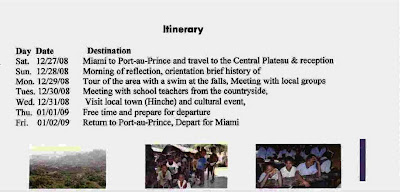
An opportunity to live and learn.

The Brigade Tour gives each member an opportunity to learn from a front row seat the history. culture, and lifestyle of the Haitians living in the countryside. The tour also gives members an opportunity to meet any of the organizations in the countryside. Haiti has a rich history and many lessons worth learning This tour gives men hers a chance to study recent and past history of Haiti taught by Haitian local and national grassroots leaders. Tour members will have the opportunity to visit famous landmarks and see some of the Haitian beautiful countryside. This tour will give its member a rare opportunity to meet and hear from the Haitian families and grassroots movements who live in the countryside.

Please help!

Monday, September 8, 2008
Brothers And Sisters International (BASI)
Invites you to
Help build relief support for Haiti after Storm Gustav
Saint Stephen Episcopal Church 1525 Newton
NW. Washington, D.C.
September 12, 2008
6:00 pm
Contact person: (301) 257-6157

Help build relief support for Haiti after Storm Gustav
Saint Stephen Episcopal Church 1525 Newton
NW. Washington, D.C.
September 12, 2008
6:00 pm
Contact person: (301) 257-6157

Chavannes Jean-Baptiste (national leader and founder of Haiti’s largest and oldest peasant movement) speaking at a gathering of peasants in Hinche, Haiti.
Come out and hear eyewitness accounts and see pictures of the devastation made by the hurricane and tropical storms in the Haitian countryside. We will also discuss the Haitian peasant's movement programs and efforts to reduce the loss of life and property and their efforts to rebuild stronger and better communities.
Thursday, August 7, 2008
Civilians have repeatedly been displaced by violence in DR Congo
"Congo groups 're-arming' in east
By Martin Plaut
BBC Africa editor

Civilians have repeatedly been displaced by violence in DR Congo
Government forces and rebel troops are rearming and recruiting for conflict in the east of the Democratic Republic of Congo, the BBC has learned.
US and European Union officials are warning the situation is increasingly tense despite a January peace deal.
One source said six plane-loads of arms and ammunition had been flown into Goma by the government in the last 10 days.
The defence minister refused to confirm or deny allegations the government was moving weapons into eastern DR Congo.
Chikez Diemu said it was an internal matter for the authorities to deal with.
Human rights groups say that tens of thousands of people have fled as the situation in the area deteriorates." Read more...
By Martin Plaut
BBC Africa editor
Civilians have repeatedly been displaced by violence in DR Congo
Government forces and rebel troops are rearming and recruiting for conflict in the east of the Democratic Republic of Congo, the BBC has learned.
US and European Union officials are warning the situation is increasingly tense despite a January peace deal.
One source said six plane-loads of arms and ammunition had been flown into Goma by the government in the last 10 days.
The defence minister refused to confirm or deny allegations the government was moving weapons into eastern DR Congo.
Chikez Diemu said it was an internal matter for the authorities to deal with.
Human rights groups say that tens of thousands of people have fled as the situation in the area deteriorates." Read more...
Danny Glover criticized for Toussaint Film
Danny Glover's slavery film lacked 'white heroes', producers said
US actor Danny Glover, who plans an epic next year on Haitian independence hero Toussaint-Louverture, said he slaved to raise funds for the movie because financiers complained there were no white heroes.
'Producers said 'It's a nice project, a great project... where are the white heroes?'' he told AFP during a stay in Paris this month for a seminar on film.
'I couldn't get the money here, I couldn't get the money in Britain . I went to everybody. You wouldn't believe the number of producers based in Europe , and in the States, that I went to,' he said.
'The first question you get, is 'Is it a black film?' All of them agree, it's not going to do good in Europe, it's not going to do good in Japan .
'Somebody has to prove that to be a lie!', he said. 'Maybe I'll have the chance to prove it.
'
'Toussaint,' Glover's first project as film director, is about Francois Dominique Toussaint Louverture (1743-1803), a former slave and one of the fathers of Haiti's independence from France in 1804, making it the first black nation to throw off imperial rule and become a republic.
The uprising he led was bloodily put down in 1802 by 20,000 soldiers dispatched to the Caribbean by Napoleon Bonaparte, who then re-established slavery after its ban by the leaders of the French Revolution.
Due to be shot in Venezuela early next year, the film will star Don Cheadle, Mos Def, Wesley Snipes and Angela Bassett.
'I wasn't the first one who had this idea,' he said. 'Sergey Eisenstein had the same idea, Anthony Quinn had this idea, Harry Belafonte, Sidney Poitier, and this goes on.
'The 'Lethal Weapon' co-star, just turned 62, finally raised 18 of the 30 million dollars needed from a Venezuelan cultural body set up in 2006 by his friend President Hugo Chavez to counter what he termed 'the Hollywood film dictatorship'. Venezuelan filmmakers last year slammed the investment.
'It is Mr Glover who should be bringing dollars to Venezuela ,' the National Association of Film Makers and the Venezuelan Chamber of Film Producers said in an open letter.
Glover, a longtime activist, has supported Chavez's political revolution since he was first elected in 1998.
After making his debut with a bit role in 1979 movie starring Clint Eastwood, 'Escape From Alcatraz', Glover played in films such as 'Silverado' and 'Witness' but grabbed wide attention after Steven Spielberg's 1985 movie 'The Color Purple'. He is probably most widely known as 'Lethal Weapon' co-star with Mel Gibson.
Born in San Francisco , he enrolled at the Black Actors Workshop there and is known for his stand against discrimination as well as for his activism against the Iraqi war and anti-personnel mines.
An admirer of the Senegalese writer-filmmaker known as the father of African cinema, Ousmane Sembene, Glover has helped produce African films, including the recently-acclaimed arthouse movie 'Bamako' by Abderrahmane Sissako.
'The first African films that I saw were films that portrayed Africans as savages, ignorant and uncivilized, and I wanted to know something else,' he said. I was very fortunate, I had the chance to read writers like Mariama Ba, Aime Cesaire ... and
Leopold Sedar Senghor. I read him when I was 20. 'When I saw Sidney Poitier on screen, I was probably 10 or 11,' he added. 'That was a different image, an image I had never seen before, on screen.
'The African-Americans I saw, they danced, they were buffoons, that was the image. So Sidney brought another image.' History, Glover said, had enabled him to play a wide range of roles because of the changes taking place in society. 'I think cinema has played a great role in our re-imagining ourselves,' he said.
Greens launch effort against Electoral College manipulation of presidential elections
Greens launch effort against Electoral College manipulation of presidential elections
Asa Gordon, Chair DC Statehood Green Party Electoral College Task Force
Executive Director Douglass Institute of Government
• Malapportionment of Electoral College votes may lead to a Republican victory despite the popular vote, disenfranchising tens of thousands of voters, especially black voters in southern states
• Green civil action seeks to democratize the Electoral College by enforcing 14th Amendment voter protections, names Vice President Cheney as defendent
WASHINGTON, DC -- Green Party leaders said today that the outcome of the 2008 presidential election may be affected by the antidemocratic apportionment of Electoral College votes, with the popular vote misrepresented by the winner-take-all system of assigning votes to electors." Read more...
Asa Gordon, Chair DC Statehood Green Party Electoral College Task Force
Executive Director Douglass Institute of Government
• Malapportionment of Electoral College votes may lead to a Republican victory despite the popular vote, disenfranchising tens of thousands of voters, especially black voters in southern states
• Green civil action seeks to democratize the Electoral College by enforcing 14th Amendment voter protections, names Vice President Cheney as defendent
WASHINGTON, DC -- Green Party leaders said today that the outcome of the 2008 presidential election may be affected by the antidemocratic apportionment of Electoral College votes, with the popular vote misrepresented by the winner-take-all system of assigning votes to electors." Read more...
Monday, February 11, 2008
Ancestors Resume shows why we must VOTE

None of us has had to experience the pain of separation or live with the disgrace and humiliation that comes with not being free. When you cast your vote for who will run our country, never forget your history and keep this bill of sale in mind. When we allow ourselves to forget our not so distant past, then we are destined to repeat these actions in our future. Stand for those who came before us and those who could not stand up for themselves. VOTE!
"Each and every one of you here has heard and felt those ceilings, somebody pushing you down, defining your limitations, who are you? You know damn well what you are capable of doing. This election is just as much about that as it is about change because the truth is there are millions of shining little lights just like me all over this country...This is an opportunity for all of us to send a different message to all those shining lights." by Michelle Obama
Peace is not the absence of war, but the presence of justice.
African adage
Brothers And Sisters International, Inc.
Paul A. Pumphrey
International Liaison
broandsisinterna@aol.com
202/232-8936
Every gun that is made, every warship launched, every rocket fired signifies, in the final sense, a theft from those who hunger and are not fed, those who are cold and are not clothed. This world in arms is not spending money alone. It is spending the sweat of its laborers, the genius of its scientists, the hopes of its children...under the cloud of threatening war, it is humanity hanging from a cross of iron.
--President Dwight D. Eisenhower--
April 16, 1953 Before the American Society of Newspaper Editors
Tuesday, February 5, 2008
Monday, February 4, 2008
Tuesday, August 14, 2007
Patterns Behind the Haitian Elections
Paul Pumphrey, 2006-04-03
Notes from his presentation on the elections at the Washington Peace Center, Thursday, March 30, 2006.
In 1975 I became interested in Haiti in the course of my intensive support work for South Africa and Namibia. In the course of that work, I met Howard University students from Haiti. Talking to them, I became interested in the problems of that country.
In 1995, I was part of a U.S. organization that was invited down to Haiti by its largest peasant league. By that time, my Haitian friends whom I had met in the 1970s had returned to Haiti to work in the movement for change. I tried to locate them.
In 1995, Haiti was preparing for elections after the return of the elected president, Jean-Bertrand Aristide, by U.S. troops in 1994. The Haitians asked us to act as international observers for the elections, and I returned in June 1995 to observe. The president of the electoral commission said to me that since we know and trust you, we would like you to observe right here in the CEP headquarters.
At that time, all members of the CEP were under threat and had bodyguards. At CEP headquarters, there were guards with shotguns. I was wary, but as a former Black Panther I had got used to the sight of guns.
At 4 a.m. on election day I was awakened and asked to observe a specific event. I would learn something from this event.
The head of the departmental electoral office (BED) for the Department of the Ouest, in which Port-au-Prince is located, had earlier reported to the CEP that he had got out all the ballots to the polling stations by 10:00 p.m. the night before. Now he called to say he had not got them out and needed fifteen vehicles from the CEP to get them out. We went to the BED. The president of the BED had his security, and the CEP members took theirs with them. There was an argument. Voices were raised, which in Haiti does not necessarily mean there will be violence. The CEP member wanted the BED president to sign a paper requesting the vehicles. The argument went back and forth. Finally the CEP member pulled out his nine-millimeter pistol and banged it on the table for emphasis. The BED president signed. On leaving the building, I made sure I walked ahead so that if there were any shooting, I would not be in the way.
From the incident, the BED president was able to generate newspaper articles alleging that the CEP was late getting the ballots out. From this, I began to see how the game was played.
Because polls opened late, they would close late. Then, as last month, the poll workers were very young. Their average age is in the twenties. They are very focused and take great pains to count the ballots properly. In Haiti, they put the candidates’ picture on the ballot and the party symbol, as half the voters cannot read. This makes for a large ballot because thirty or forty candidates are vying for the same position. It is a painstaking process. Many polls had no electricity. After 6 p.m. it became pitch dark. They were counting the ballots by candlelight. They were looking at each ballot and recording it.
In the four elections I have observed in Haiti, it was the same. Poll workers are there at three or four o’clock in the morning. They are supposed to count each and every blank ballot that is delivered, so that there will be an accurate count of how many ballots they started with, how many were voted, and how many were returned unused. They count them twice to be sure.
So, these young poll workers begin in the dead of night, work through the next day, and frequently way into the next night and morning completing the count. Often, when I hear quick accusations of cheating, I remember how dedicated these workers are.
This time they combined several precincts into one voting station. People had to walk long distances. They had laminated voting cards with their pictures. They would present their cards at the table. The electoral workers had printouts with copies at table. They then keep the card, the person is given ballots. The area is secluded but not terribly secret. The ballot is put in transparent plastic box. Ink is put on their thumb. They are given back their voter’s card.
Subscribe to:
Posts (Atom)

 Posts
Posts